Research
Effects of Neonicotinoid Pesticides on the Mammalian Central Nervous System
 Neonicotinoid pesticides are insecticides developed in the 1990s based on the chemical structure of nicotine found in tobacco plants. By targeting nicotinic acetylcholine receptors (nAChRs) in the insect nervous system, they offer high selective toxicity, systemic properties within plants, and environmental persistence. Consequently, they have become among the most widely used pesticides globally. Beyond agricultural applications, neonicotinoids are contained in common household consumer products, and recent reports highlight the frequent detection of multiple neonicotinoid residues in human urine samples.
While neonicotinoids were initially considered safe for mammals, a seminal 2012 study by Dr. Junko Kimura-Kuroda and her research group demonstrated using cultured rat neurons that early-generation neonicotinoids, such as imidacloprid and acetamiprid, trigger excitatory responses via nAChRs in a manner similar to nicotine (Kimura-Kuroda et al., 2012, PLoS ONE). Since then, deep concerns have emerged regarding their potential impacts on higher-order brain functions, as well as psychiatric and neurodevelopmental disorders in mammals, including humans.
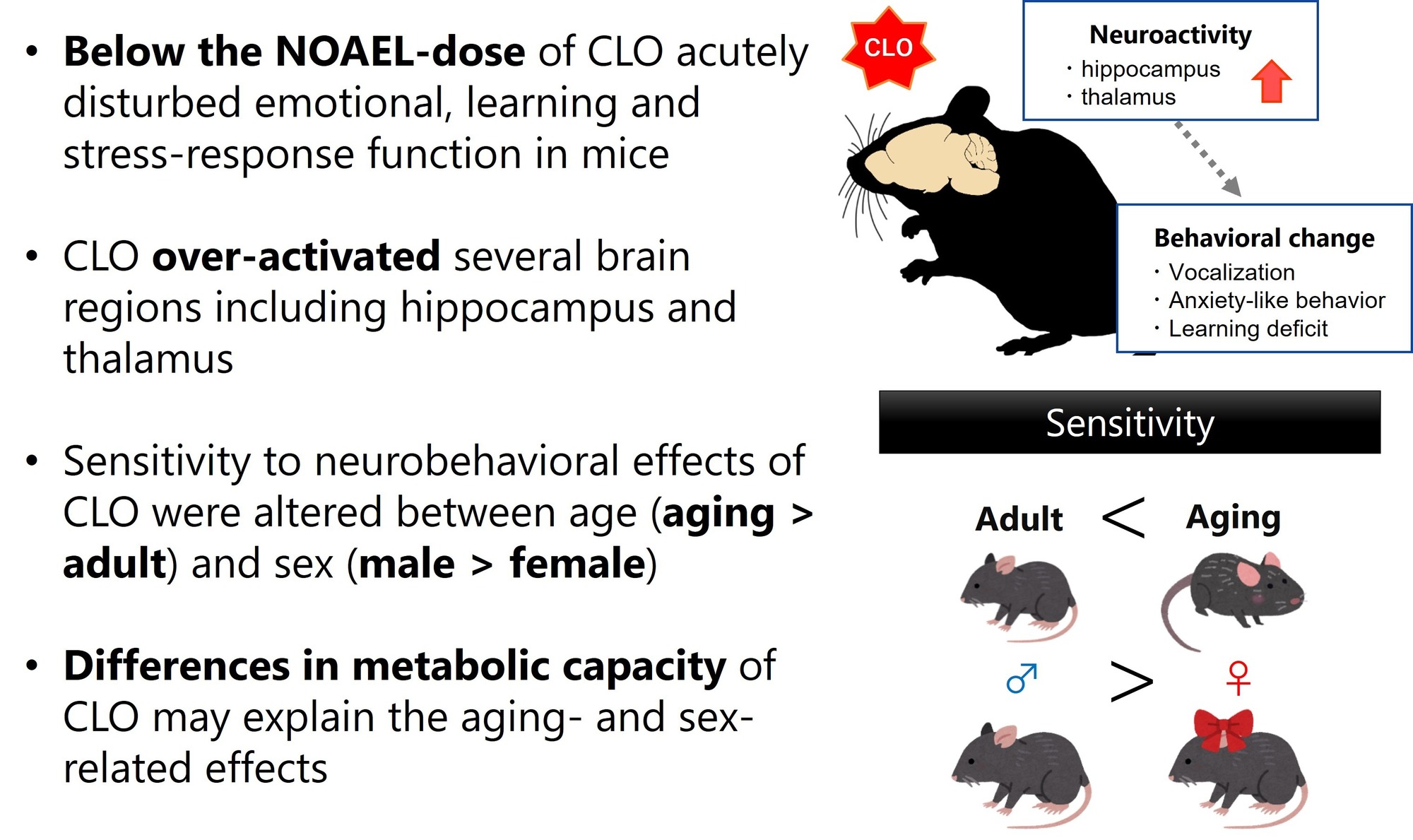
Our laboratory has focused its research on clothianidin (CLO), one of the most heavily used neonicotinoids in Japan. Remarkably, we discovered that a single exposure to CLO at a dose below the No-Observed-Adverse-Effect Level (NOAEL)—the threshold where conventional toxicity testing detects no adverse effects—induced excessive stress responses in mice, such as anxiety-like behaviors and abnormal vocalization. Furthermore, we confirmed elevated neural activity in brain regions involved in anxiety and stress, including the hippocampus and the thalamus (Hirano et al., 2018, Toxicol. Lett.).
We have also demonstrated that susceptibility to these acute effects varies significantly by age and sex, with aged mice and male mice showing higher vulnerability (Hirano et al., 2021, Toxicol. Lett.; Kubo et al., 2022, Toxicol. Appl. Pharmacol.). These findings serve as a crucial foundation for reevaluating the potential risks that neonicotinoid pesticides pose to the mammalian brain.