Research
Unraveling the Mechanisms: How Neonicotinoid Exposure Affects Next-Generation Higher-Order Brain Functions
The next compelling question that emerges is: How do neonicotinoid pesticides, which clearly impact the mammalian brain and behavior, transfer to the next generation and exert their effects?
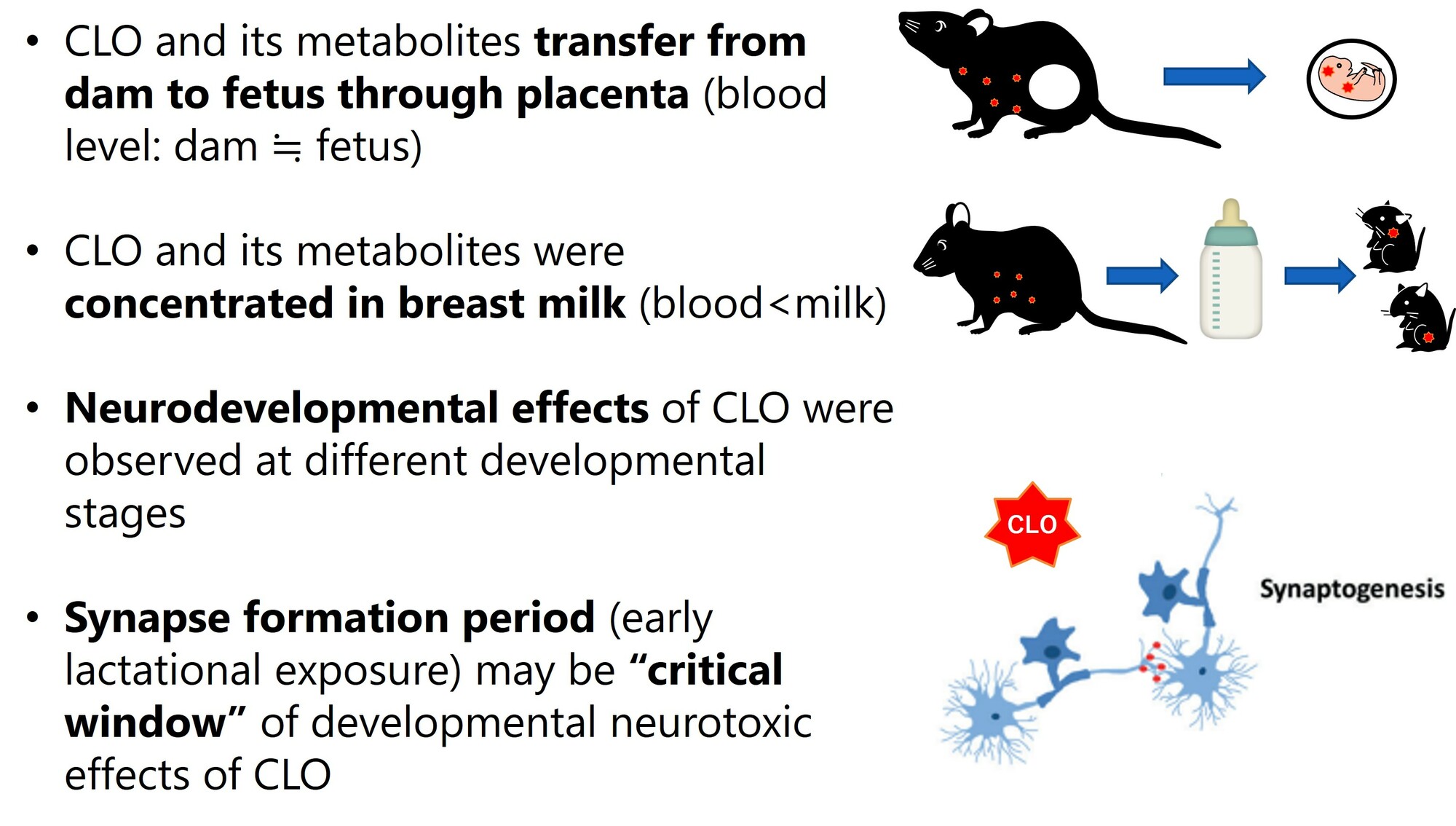
To address this, we first investigated whether the neonicotinoid clothianidin (CLO) transfers to fetuses via the placenta when administered to pregnant mice. Our results revealed that CLO and its metabolites were detected at equivalent levels in both maternal and fetal tissues. Strikingly, in certain organs such as the brain and kidneys, chemical concentrations were even higher in the fetuses than in the mothers (Hirano et al., 2024, Toxicol. Appl. Pharmacol.). Next, we examined lactational transfer to the next generation by administering CLO to nursing maternal mice. We discovered that ingested CLO is rapidly metabolized and transferred into breast milk. Notably, because the concentrations in breast milk exceeded those in maternal blood, our study demonstrated for the first time that CLO and its metabolites accumulate from maternal blood into breast milk during transfer to offspring (Shoda et al., 2023, Toxicol. Lett.).
Given that neonicotinoids readily cross the placental and lactational barriers, how exactly do they affect the brain and behavior of the next generation? To investigate this, we exposed maternal mice to CLO at the NOAEL (No-Observed-Adverse-Effect Level) throughout the gestational and lactational periods. We then analyzed the offspring’s behavior and brain pathology at 3 weeks of age (corresponding to childhood) and 10 weeks of age (corresponding to adulthood). Interestingly, we observed age-dependent behavioral alterations: 3-week-old offspring exhibited anxiety-like behaviors in novel environments, whereas 10-week-old offspring displayed increased locomotor activity. Concurrently, in the hippocampal dentate gyrus, we detected distinct changes in the number of c-Fos-positive cells (a marker for neural activity) and DCX-positive cells (a marker for immature neurons). This indicates that CLO exposure during prenatal and lactational stages alters brain development, and these structural and functional changes in the brain underlie the subsequent behavioral abnormalities (Maeda et al., 2021, J. Vet. Med. Sci.).
Furthermore, to pinpoint precisely which phase of brain development is most vulnerable to neonicotinoids, we investigated the "critical window" of developmental neurotoxicity. Brain development progresses through defined stages: (1) proliferation and differentiation of neural stem cells, (2) neurite outgrowth, (3) synaptogenesis, and (4) neural network formation. We exposed maternal mice to CLO for only 4-day windows corresponding to each specific stage. Remarkably, behavioral analysis showed that exposure only during the synaptogenesis period (stage 3) replicated the increased locomotor activity at 10 weeks of age, matching the effects seen in full gestational-to-lactational exposure. These findings strongly suggest that CLO exposure during the critical window of synaptogenesis is the decisive factor driving behavioral alterations in the next generation (Shoda et al., 2023, J. Vet. Med. Sci.).